Home › Services › Flow Elements › Averaging Pitot Tube
Averaging Pitot Tube Design
Insertion Type · Low Cost · Minimal Pressure Loss · Hot-Tap Capable
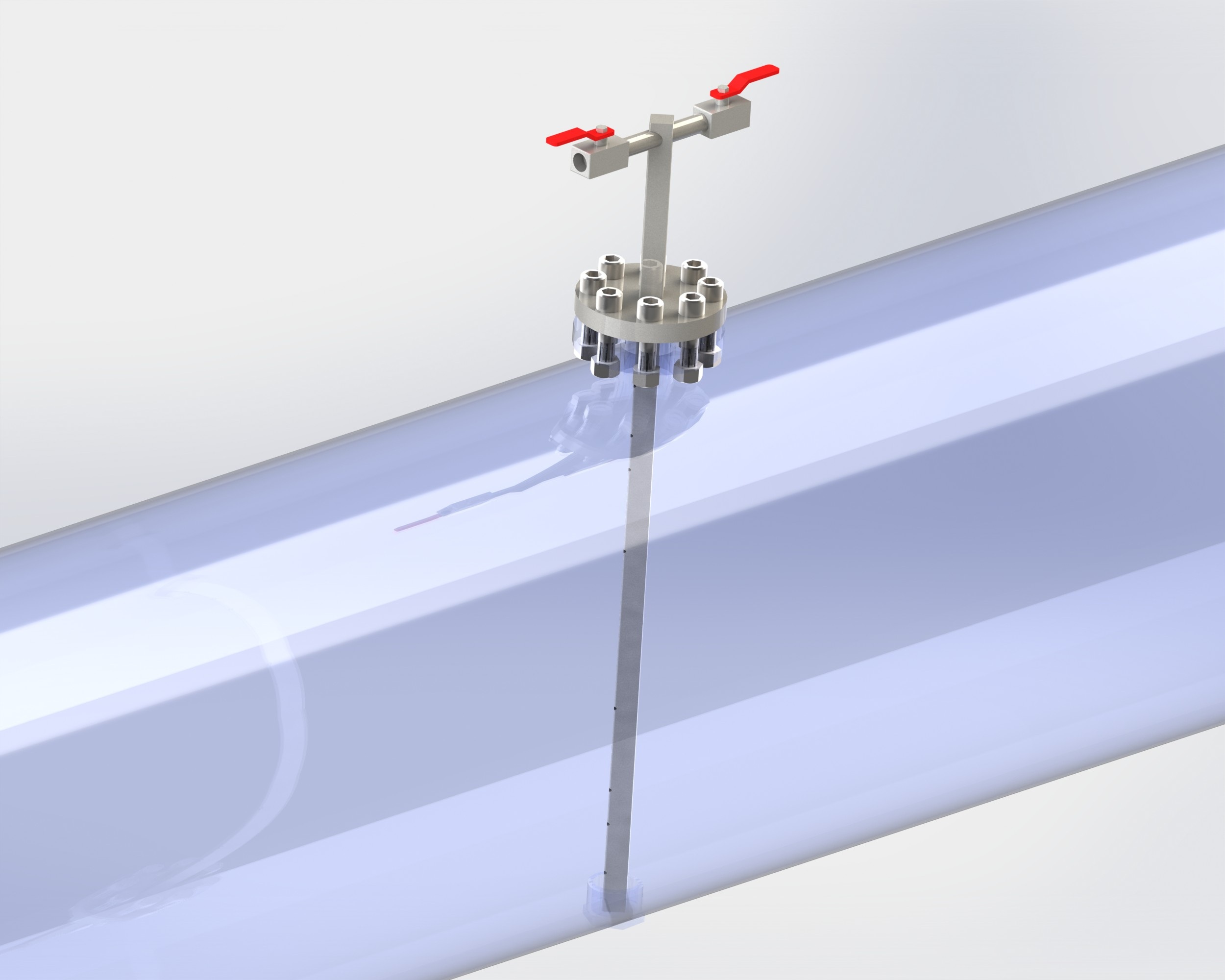
An averaging pitot tube is an insertion-type flow element consisting of a bar or probe inserted across the pipe diameter, with multiple sensing ports facing upstream at defined positions across the velocity profile. The impact pressures sensed at these ports are averaged internally to give a representative high-pressure signal, while a low-pressure signal is taken from ports on the downstream side of the probe, in its wake.
The resulting differential pressure between the averaged upstream impact pressure and the downstream wake pressure is related to the average flow velocity, and hence flow rate, across the pipe cross-section — without requiring the full-bore restriction that orifice plates, nozzles, or venturis rely on.
Design Basis
Minimal material and machining make it the most economical primary element option, especially for large pipe diameters.
The slender profile occupies a small fraction of the flow area, producing negligible permanent pressure loss.
Can often be installed or removed under live process conditions through a hot-tap fitting, without a full shutdown.
Cost advantage grows with pipe size, making it attractive for large-diameter duct and pipeline applications.
The generated DP is much smaller than an orifice or venturi, requiring a sensitive, low-range transmitter for good turndown.
Sensing ports can become partially blocked by debris or scale, degrading accuracy if not periodically inspected.
Generally less accurate than orifice plates, nozzles, or venturis for high-precision custody transfer applications.
Accuracy depends on a well-developed velocity profile, so adequate straight lengths and correct orientation are still required.
Our engineers will size and specify an averaging pitot tube for your pipe size, process conditions, and installation constraints.
Discuss Your Requirements